
ICE Center Release Outcomes
South Louisiana ICE Processing Center is a federal immigration detention facility in Basile, operated under ICE oversight. Its records do not describe a parish sentence, a Louisiana prison discharge, or a local bond release. A person leaving this facility may be released from ICE custody with reporting instructions, moved to another immigration detention site, or otherwise proceed under the controlling immigration process. The next status must come from ICE and the person’s paperwork.
A prior APSO record may still be important. If the sheriff’s system shows ICE or USICE as the held-for agency or destination, that record establishes the end of parish custody and points to the federal system. It does not establish the end of detention. Conversely, an ICE release does not decide a criminal charge that may exist in a separate court. The custody chain and the legal proceedings must remain distinct.
| Event | Best evidence |
|---|---|
| APSO transfer to ICE | APSO release or destination record paired with an ICE custody result |
| Current ICE detention | ICE ODLS result and confirmation through the official facility channel |
| Release from ICE custody | ODLS when covered, release paperwork, and current ICE reporting instructions |
| Movement to another facility | Updated ICE location and direct confirmation from the appropriate facility |
Confirm ICE Center Releases
The correct public search is the ICE Online Detainee Locator System, commonly called ODLS. Search with the nine-digit A-number and country of birth when those details are known. The other route requires exact biographical information. People under 18 are excluded. ICE states that ODLS includes current detainees and many people released from ICE custody within the prior 60 days, but not every person appears and uploads can lag.
- Choose the A-number search when the number and country of birth are available, or enter exact biographical data.
- Read the result as an ICE custody record, not as proof of a criminal case outcome.
- When the facility is identified, use ICE’s official page to confirm the current contact and visitation route.
- If ODLS shows no result, recheck the spelling and identifiers, then contact the appropriate ICE or facility channel.
- For a claimed release, compare ODLS with the dated release paperwork and all stated check-in instructions.
A blank ODLS search does not prove release. It may reflect timing, data limits, a spelling issue, or a person outside the locator’s scope. Likewise, a recent released result does not prove that all immigration or court obligations ended. The Acadia Parish source chain is covered in the released inmate search when a sheriff booking came first. Note: Save the search date and identifiers used because the locator’s recent-release window is limited.
ICE Center Official Contact
The research identifies the Basile facility through ICE’s official detention-facility page. It does not supply a stable street address, telephone number, records schedule, or fee that should be copied into a fixed contact card. Those operational details can change. Use the live federal page for current contact, visitation, attorney, and facility instructions rather than relying on parish jail information.
South Louisiana ICE Processing Center
Basile, Louisiana
Federal immigration detention
Use the official ICE facility page for current contact and visitation details
The official South Louisiana ICE Processing Center page is also the source of the facility view below.
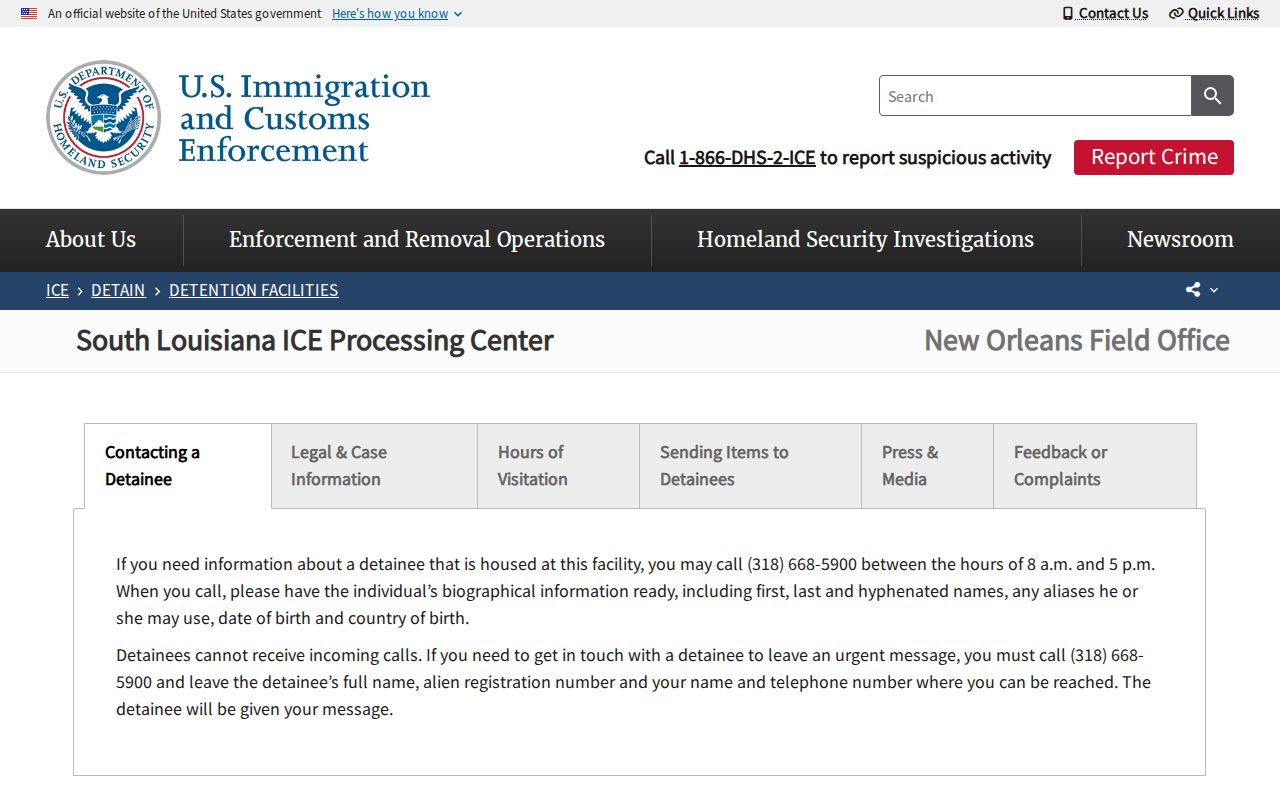
The captured page confirms the Basile facility identity and gives readers the right federal channel for current instructions, while ODLS remains the correct public custody lookup.
Acadia Parish ICE Transfers
The APSO portal includes ICE and USICE among its held-for choices, and the Basile processing center makes that destination concrete for Acadia Parish. A person may leave the Acadia Parish Detention Center or Jail while remaining physically detained under a different sovereign. That is a transfer from parish custody. It should not be counted or described as a community release.
An immigration detainer asks a local agency to notify ICE and allow ICE to assume custody when the person would otherwise be releasable. ICE states that the local agency must release the person if ICE does not take custody within the permitted 48-hour detainer period. Still, the existence of a hold is not proof of pickup. Confirm the actual result with APSO’s destination record and ODLS. A two-record chain is much stronger than a roster disappearance or a held-for label alone.
ICE and Parish Facility Labels
Acadia Parish sources use Detention Center, Parish Jail, and Criminal Justice Center labels for local sheriff contacts, while APSO describes one 190-bed corrections operation. South Louisiana ICE Processing Center is different. It is a separate federal immigration custody channel in Basile and must not be folded into the parish operation. The official-label ambiguity applies to the sheriff locations, not to ICE’s legal role.
This distinction changes the search system. APSO’s portal can record the parish release and point to ICE. ODLS then covers eligible ICE custody and recent-release results. Louisiana VINE and the DPS&C telephone locator are state custody tools, so they are not substitutes for ODLS. BOP is a federal criminal custody system and also does not replace the immigration locator. Using the agency named in the record prevents a false conclusion based on geography.
Note: Facilities can be close in place while belonging to separate sovereigns, records systems, and definitions of release.
After an ICE Center Release
Physical release from South Louisiana ICE Processing Center may come with ICE check-in duties. ICE check-ins are separate from immigration court appearances and are identified in the release papers. The paperwork is therefore central evidence. It can show the date custody ended, the office or process for later contact, and instructions that a public locator result may not reproduce.
Do not treat an ODLS disappearance as proof that the person completed every obligation. Ask the person or authorized representative to read the release papers, and use official ICE channels to verify the next required step. A release from immigration detention also does not erase a separate local, state, or federal criminal case. If APSO or a court record preceded the ICE detention, preserve those records as separate events rather than blending them into one release date.
- ICE custody release
- The end of physical detention under ICE for the event shown.
- ICE check-in
- A post-release immigration reporting duty stated in the release paperwork.
- Immigration court appearance
- A separate proceeding that should not be confused with an ICE check-in.
- Transfer
- Movement between custodians or facilities rather than release into the community.
ICE Center Release Records
ODLS is a locator, not a complete historic case file. Its stated recent-release coverage reaches many people released during the prior 60 days, and not everyone appears. For an older or disputed event, release paperwork and official agency records carry more weight. A narrow inquiry should identify the A-number when lawfully available, exact name, date of birth, facility, and approximate date. Ask for the precise custody or release record rather than an undefined collection.
When the issue began with an Acadia Parish transfer, request the APSO booking and release summary as the first half of the chain. Ask for its date and time, release code, and receiving agency. Then seek ICE confirmation for the later event. A federal court record may be needed only when a separate federal proceeding controls. The BOP locator is appropriate for a person committed to federal criminal custody, not for ordinary ICE detention. Each system proves only the event it records.
No research source verifies release-processing hours, a public waiting place, property-return steps, transportation pickup rules, or a fixed records fee for the Basile facility. Obtain current instructions through ICE’s live facility page. Do not import county jail customs. Before arranging travel, confirm the current location and whether the expected event is release from ICE, transfer elsewhere, or a legal appointment that does not itself end detention.
Identity errors can also explain a failed locator search. ODLS expects exact data, and the A-number route must be paired with country of birth. Recheck those inputs without publishing private details. If a current or recent record still cannot be located, preserve the date of the search and seek official confirmation. The accurate conclusion is that the person was not located in the public search, not that ICE custody or all federal obligations ended.