
Acadia 24-Hour Release Source
No official APSO page is labeled as a rolling 24-hour release list. The documented source is the Acadia Parish Sheriff Zuercher portal, which has a calendar-based Release Date filter. It can return a booking recorded as released on a chosen date. That is stronger evidence than seeing a name vanish from the older current-population roster. It is still evidence from one custodian only. The result means APSO marked that booking as released from parish custody.
A parish release may lead to the community, probation, state custody, another jail, ICE, or the U.S. Marshals Service. The portal's held-for agency can point toward the next check. A release result without a destination should be described in limited terms. It should not be called a confirmed return to the community.
Note: The older Acadia LAVNS roster presents current population data and is not a verified archive of released bookings.
Search Acadia Releases by Date
A rolling day rarely matches one calendar date. At 3:00 p.m., for example, the prior 24 hours began at 3:00 p.m. the day before. Both the prior date and today's date intersect that window. Search both. If the public result shows only a date, it cannot prove that the event fell after the exact start time. The safest label is “released on a calendar date intersecting the last 24 hours” until APSO confirms the recorded time.
- Write down the current date, time, and Central Time reference. Work back exactly 24 hours to define the start boundary.
- Open the APSO portal. Use Release Date for the earlier calendar date, then repeat the search for the current date.
- Match each result by name, age, arrest date, agency, and charge or hold details. Do not rely on a common name alone.
- Record the dates searched and the time of the check. Count a booking once, even when several charge lines appear.
- Call APSO Corrections at 337-788-8737 when an exact release time, type, or destination is needed.
For a named person rather than a full same-day scan, the Acadia Parish released inmate search connects the local result to court, state, and federal sources. That broader path matters when the held-for field names an outside custodian.
Acadia 24-Hour Release Fields
The public portal exposes a useful but limited set of fields. Not every booking fills every value, and a photo can be null. Detail data may add a hold reason, charge narrative, bond, or judge. None of those extra fields, by itself, proves why the person physically left or where the person went next.
| Portal field | What it supports |
|---|---|
| Name, race, sex, age | Identity comparison across possible same-name results. |
| Arrest date | Connects the release result to the correct booking event. |
| Held-for agency | Identifies the agency connected to custody and may point to a receiving custodian. |
| Release date | Shows the calendar date APSO recorded the booking as released. |
| Mugshot | May help identify the booking, but the field may be blank. |
| Bond, judge, charge | Provides case leads in detail data, not proof of completed release conditions. |
The official portal image below shows the documented release-search source used for an Acadia Parish same-day review.
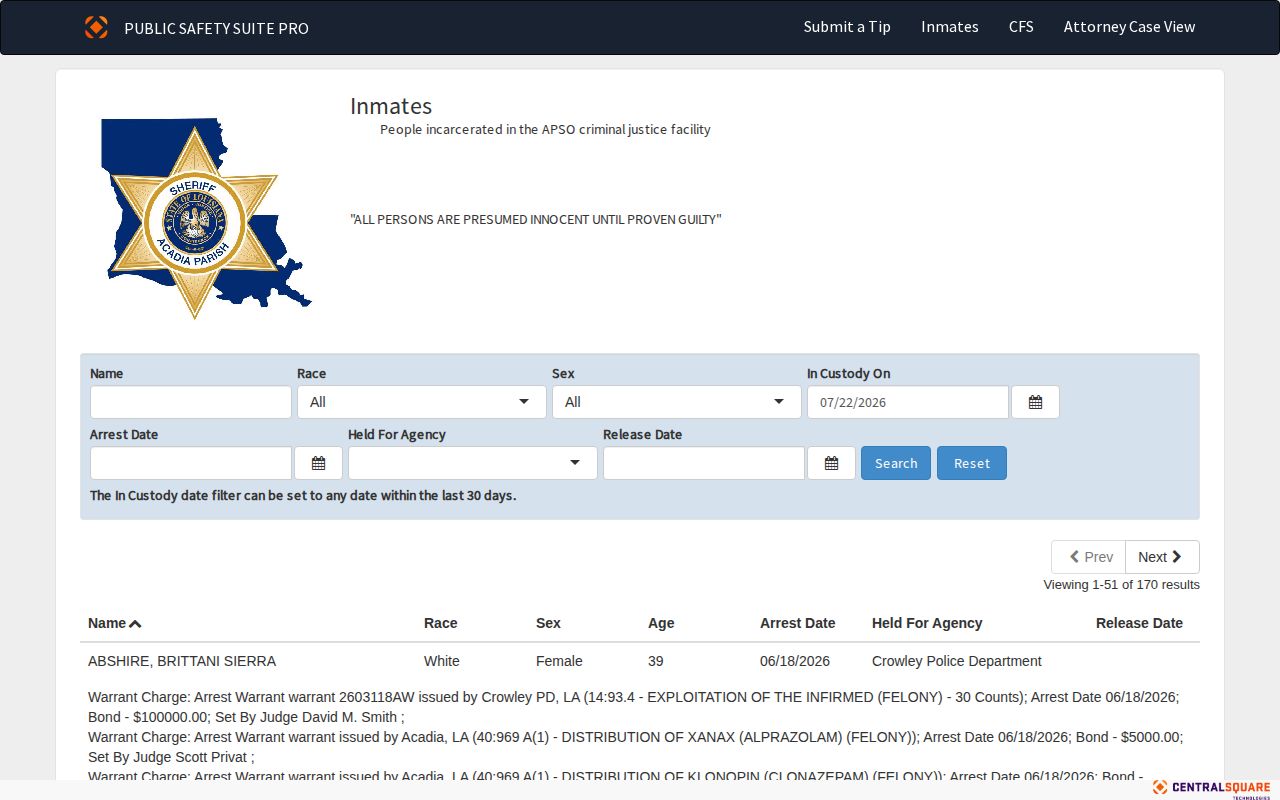
The screenshot should be read as an example of the date-filter method, not as a branded or complete rolling 24-hour feed.
Bond Is Not Acadia Release
The APSO portal can display bond and judge details, while the sheriff's Traffic and Bonds unit processes bonds and court findings. A listed bond amount means a court or schedule authorized an amount. It does not prove that funds or conditions were satisfied. Processing may still be underway, and a second case or outside hold can prevent departure.
Confirm bond release with a portal release date or direct jail confirmation. Then use the court's bond order or disposition if the legal basis matters. The physical custody event and the court action are two records. Their timestamps may differ. When one charge has a bond but another hold remains, the person can stay in custody despite the displayed amount.
Missing Acadia Same-Day Results
A blank search is not proof that no one was released. First, check both intersecting dates and try known spelling variants. The portal's retention period and update cadence are not published. A sealed or expunged record may also be absent from public view, while the agency may still retain a record under its approved schedule. Record what was searched rather than claiming the event does not exist.
For a parish booking, call APSO Corrections and ask whether the booking ended, what date and time are recorded, what release type or code applies, and whether another agency received the person. If staff cannot answer by phone, send a narrow public-record request through the official APSO contact channel. Identify the person, approximate booking date, and facility. Request the booking and release time, release type, destination, and legal basis for any withheld part. APSO publishes no copy fee, so request an estimate first.
A state-felony case uses Louisiana VINE and the DPS&C locator. An ICE or USICE hold leads to the ICE locator, while a USMS entry leads to the federal court and, after commitment, BOP. These checks prevent a transfer from being counted as a community release.
The Acadia Parish Clerk provides the durable district-court record when the reason for release must be proved. A court minute or disposition can show dismissal, a bond order, credit for time served, sentence, or probation. It may not show the exact jail checkout time. Pair the legal record with the APSO release entry instead of asking either source to answer both questions. Municipal cases may remain with the city court, so first identify which court handled the charge.
Note: “Not immediately available,” “not retained,” and “exempt” are different responses and should be documented separately.
Acadia Release Date Limits
Acadia's exact-date control makes a search repeatable. It also sets a clear limit. The portal does not advertise an exact rolling interval, release-time field, archive length, or immediate posting. Anyone recording a 24-hour result should state the two calendar dates searched and the reference time. If a count is published, repeated charge rows should not be counted as separate people.
Booking identifiers are the best tool for deduplication when they are visible. If no booking number appears, compare the arrest date, release date, person fields, and agency. Describe the item as a booking result when uniqueness cannot be established. Repeat the search later if a very recent event is expected, but do not assign a made-up delay to APSO.
The release reason also needs care. Time served describes credit applied to a sentence, not a dismissed case. Probation places a person in the community under court terms. Parole or good-time supervision can begin after state incarceration, while expiration may refer only to one part of a sentence. Escape and death end ordinary physical presence but are not releases. Use the agency's own classification and do not infer a reason from roster absence.
The broader Acadia Parish 72-Hour Releases method normally touches four dates and is better for reviewing a long weekend. It uses the same official portal, with a different time boundary and a stronger need to remove duplicate bookings.
Acadia Release App Limits
APSO promotes an official Acadia Parish Sheriff's Office app with an Inmate Info feature. It is a valid secondary access channel. Research did not verify a separate recent-release screen, a Release Date filter, or post-release photo retention in the app. The web portal remains the documented source for exact-date release searches.
The official app can help a user reach sheriff information while away from a desktop. It should not be described as a complete archive or a substitute for the booking and release record. The official app listing shown below documents the Inmate Info feature.
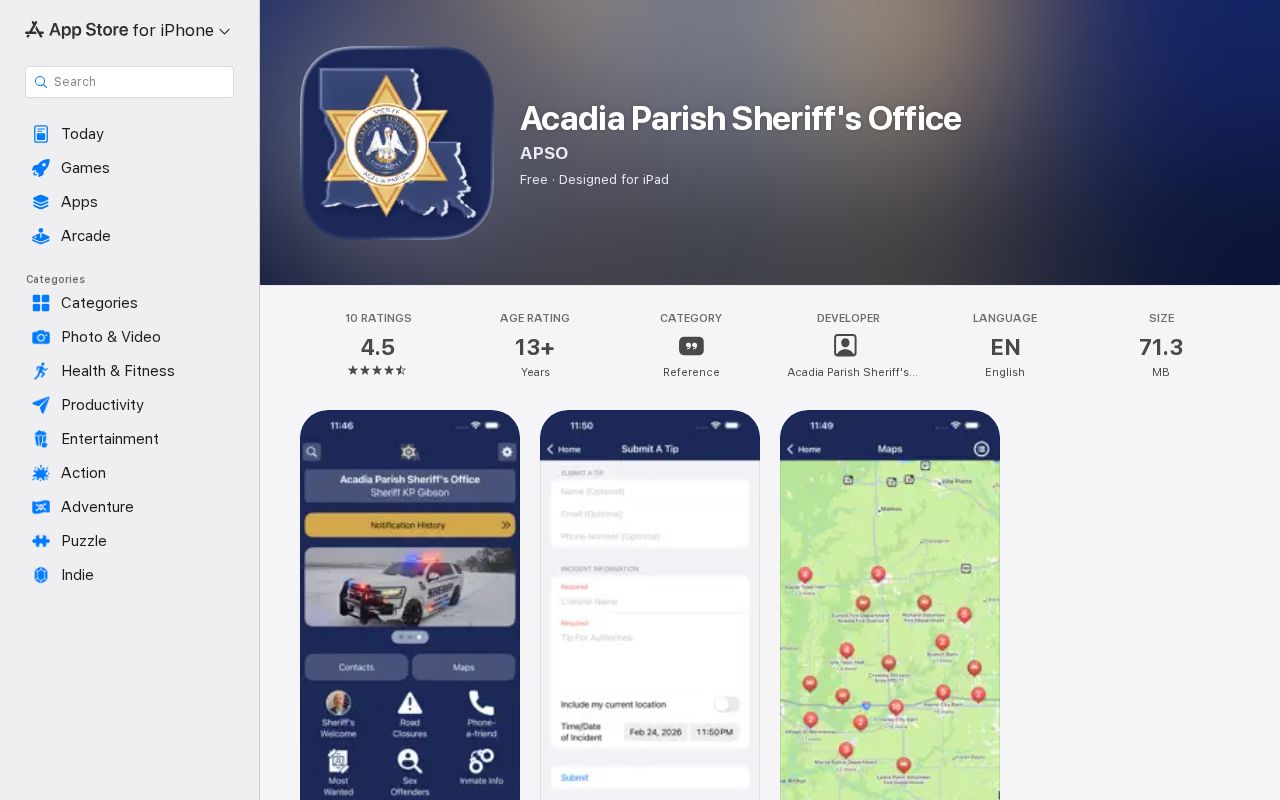
The image confirms the app's official inmate-information role, but it does not establish a rolling Acadia Parish release list.