
Acadia Parole Versus Probation
Parole and probation both allow a person to live in the community under conditions, yet their legal paths differ. Parole follows incarceration and can include good-time or diminution supervision. Probation comes from a court judgment and can follow a suspended sentence, split sentence, or local disposition. A probation entry does not prove that the person served time in a Louisiana prison.
| Point | Parole | Probation |
|---|---|---|
| How it begins | Release from incarceration under parole or diminution rules | Court orders community supervision as part of sentence |
| Primary proof | DPS&C release record, supervision status, and parole certificate | Signed judgment, court minutes, and supervising assignment |
| Decision authority | Committee on Parole or applicable release law | Sentencing court |
| How it ends | Discharge at the end of the parole term or other lawful action | Court or supervising authority records completion or discharge |
Louisiana VINE can include active incarceration, parole, and probation. Read the category shown. A P&P result supports active community supervision, while the preceding custody or release record is needed to prove a prison release.
Verify Acadia Post-Release Supervision
Begin with an identifier whenever possible. Common names can lead to a wrong match, and a missing online result can reflect spelling, timing, feed limits, or final discharge. The verification path should connect the legal judgment, custody event, and current supervision status instead of asking one record to answer all three questions.
- Search Louisiana VINE by name or ID and compare the person, offender number, status, and location.
- If the result identifies probation or parole, note the category and assigned district information rather than calling it a generic release.
- Call the DPS&C locator at 225-383-4580 when the online record is incomplete; the automated system may identify the P&P district.
- Contact Lafayette District P&P for routing and the proper verification or record-request procedure.
- Use the Acadia Parish Clerk judgment for probation and the DPS&C release or parole certificate for a prison-to-parole event.
The Acadia Parish release search and records path explains how to establish the earlier physical release. Supervision is the next legal status, not a substitute for the release record.
Acadia Supervision Uses Lafayette District
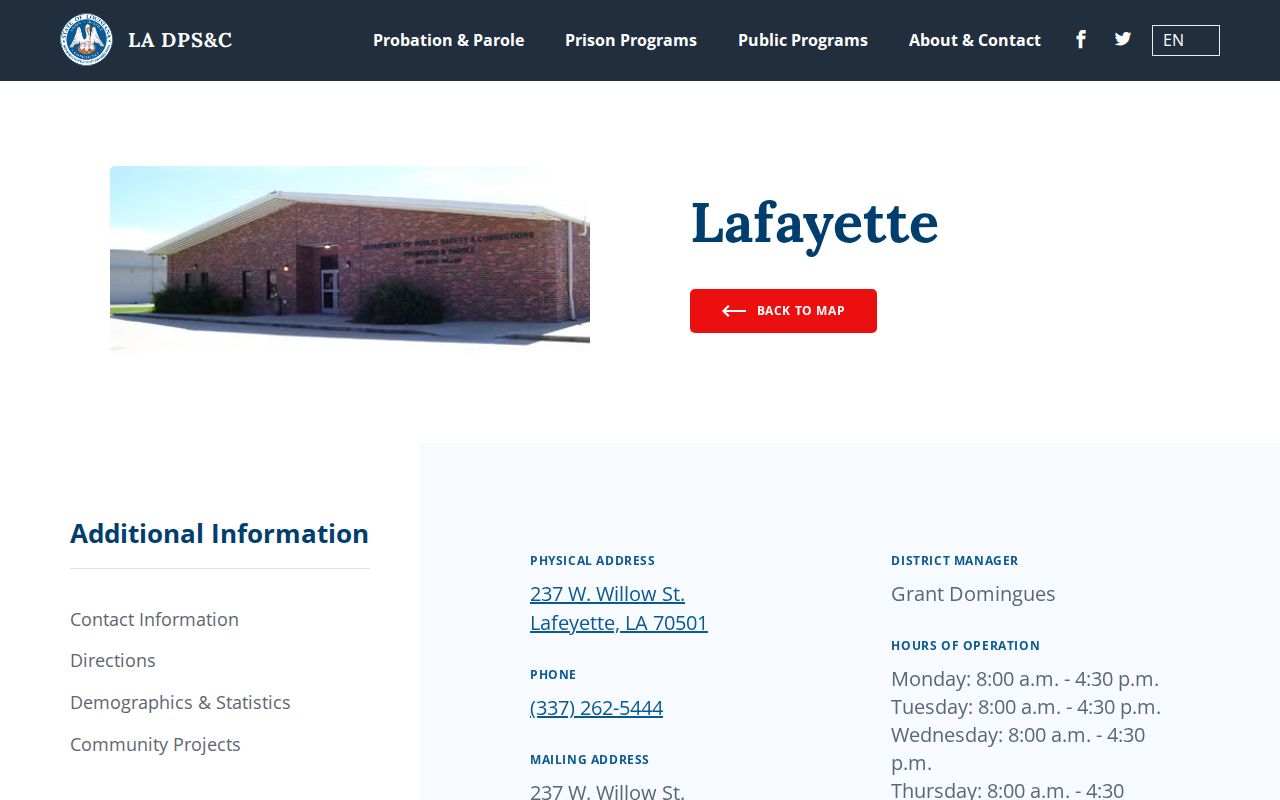
Lafayette District Probation and Parole is the named DPS&C office serving Acadia, Lafayette, and Vermilion parishes. It is the concrete local route for an Acadia assignment. The public should not expect protected case details, but staff can identify the correct unit and explain how to verify or request releasable information.
237 W. Willow St.
Lafayette, LA 70501
337-262-5444
Monday through Friday, 8:00 a.m. to 4:30 p.m.
The district page names Grant Domingues as manager as of the research date and reports about 4,200 cases and 2,100 investigations annually. Those are agency-page workload figures without a stated year, not an Acadia-only caseload. The broader Region 3 number, 337-321-1288, is a secondary routing option when district assignment is unclear.
The official Lafayette District listing below confirms the Acadia coverage, location, phone, and published hours.
This office handles state P&P routing; misdemeanor probation may use a different local channel.
First Acadia Parole Reporting Deadline
Statewide parole conditions require a parolee to report to the assigned P&P office no later than 48 hours after release, then report monthly by the fifth and as otherwise directed. For an Acadia residence or assignment, Lafayette District is the documented office. That pairing makes the district a practical immediate post-release route.
The reporting duty does not prove the jail or prison actually completed release on the Board's decision date. Use the custody event or release certificate for that fact. Nor should a public caller expect the office to disclose protected supervision details. Ask which office is responsible, what public status can be confirmed, and how to request an appropriate record.
A parole grant, future eligibility date, or docket listing does not establish same-day release. Confirm the physical event through DPS&C.
Acadia Parole Dockets and Results
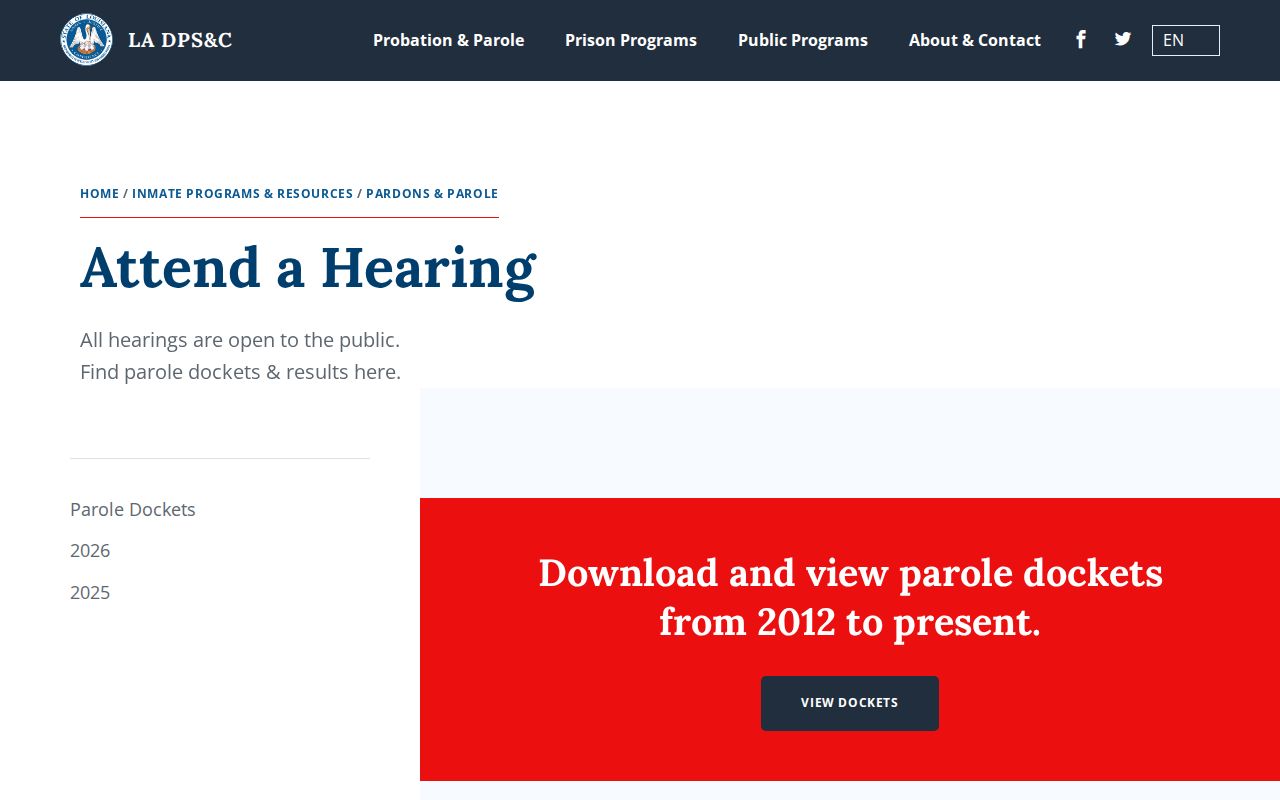
The Louisiana Committee on Parole docket page publishes notices, agendas, dockets, and results by hearing week rather than by parish. Its linked historic database covers dockets from 2012 forward. A DPS&C guide says docket pages update at noon each weekday and remain subject to change, so verify the current agenda before relying on a date.
Primary outcomes include grant and deny. Procedures can also produce deferral, reconsideration, or rehearing. A grant may still depend on conditions or an approved release plan. A denial addresses that request at that hearing, not every other release mechanism or later hearing. R.S. 15:574.4 has many offense-date and category rules, and DPS&C calculates eligibility. One percentage cannot be applied across all cases.
The current parole access page shows how weekly materials and results are organized.
The docket proves a scheduled or decided parole matter. Pair the result with DPS&C custody status before stating that release occurred.
Acadia Supervision Violations and Warrants
Supervision conditions can require reporting, residence approval, travel limits, lawful conduct, treatment, fees, or other case-specific duties. The certificate, judgment, and officer instructions control the individual case. General agency material should not be used to invent a person's terms.
An alleged violation or absconder status does not erase the earlier release. “Absconder” generally means a person is alleged to have stopped reporting or cannot be located by supervision. A warrant or revocation process may return the person to custody, but it is a later event. No Acadia-specific public absconder list was verified. Check current VINE status, the supervising office's public procedure, and the appropriate court or Board record.
- Violation
- An alleged failure to follow a supervision condition.
- Absconder
- A supervision label for someone alleged to have stopped reporting or whose location is unknown.
- Revocation
- A formal process that can cancel supervision and return a person to custody.
- Discharge
- The recorded end of the active supervision term.
Acadia Release Reentry Support
DPS&C describes its Return for Good process as a continuum from prerelease work through supervision discharge for eligible participants. Lafayette District also includes a Day Reporting Center, which DPS&C presents as a community-based supervision and support setting. These programs can help connect custody transition to the community phase.
Eligibility and services are individual. The published framework should be used for navigation, not as a promise that every released Acadia Parish person can enroll or receive the same help. The supervising officer, release paperwork, and district office remain the sources for actual requirements and referrals.
Documents for Acadia Supervision Release
DPS&C transition staff work to gather at least two identity documents during the agency's prerelease process. The department describes requests for replacement birth and Social Security documents and creation of an OMV state identification card. This is a state transition detail, not a published APSO jail-release service.
Keep the identification papers with the release certificate, judgment, and supervision instructions. A parole certificate helps prove the prison-to-supervision transition. A probation judgment explains a court-ordered community sentence. A final discharge letter proves that active supervision ended. Each record has a distinct role, and a missing LAVNS result should never be translated into sentence completion without the formal record.
Confirm Acadia Supervision Discharge
Final discharge means the active supervision term has ended. Louisiana VINE is described as including active incarceration and active supervision, so a person may stop appearing after discharge. That absence is not affirmative proof. Request the supervision discharge certificate or agency record, and use court minutes where the court controlled probation.
Diminution release can also place a person on parole until the full-term date. Under R.S. 15:571.5, “released” can therefore mean out of confinement but still subject to conditions. Confirm both milestones: the physical release from custody and the later end of supervision.
Ask for the record by its specific purpose. A DPS&C release certificate documents the move from incarceration into parole or diminution supervision. A Lafayette District assignment identifies the office responsible for an active term. A supervision discharge letter documents the later end of that term. For probation ordered in an Acadia district case, the Clerk's judgment and later court minutes can establish the sentence and completion action. Municipal misdemeanor probation may follow another court route, so the district criminal file should not be assumed to hold every local probation record.
Dates should also be labeled precisely. A parole eligibility date is only the point at which legal consideration may become possible. A Board result records the decision. A release date records the custody event. A full-term or discharge date records the end of the remaining legal term. Keeping those milestones separate prevents a hearing schedule or passed estimate from being reported as completed supervision.
Note: A discharge certificate is stronger evidence of completed supervision than an old projected date or an empty online search.