
Acadia 72-Hour Release Source
The official APSO portal is the local source for a dated release review. Its filter searches a selected calendar Release Date. Research found no distinct sheriff URL labeled “72-hour releases,” “recent releases,” or a similar rolling feed. The correct method builds the three-day window from separate exact-date queries instead of treating the current jail roster as a history page.
A roster absence has several possible meanings. The person may have posted bond, completed time, transferred to DPS&C, moved to another parish, entered ICE or federal custody, or left the display for another reason. A dated portal result is better evidence because APSO recorded the booking as released. The held-for agency and destination still need review before the event is called a community release.
Build Acadia's 72-Hour Window
A 72-hour interval that begins partway through a day touches four dates. At 3:00 p.m. on July 20, the interval starts at 3:00 p.m. on July 17. Searches are therefore needed for July 17, 18, 19, and 20. Searching only three dates drops the first partial day and may add hours outside the true period. Write down the reference time and use Central Time so another person can reproduce the review.
- Record the current date and time, then subtract exactly 72 hours to find the start boundary.
- List every calendar date touched by that interval, including each partial boundary date.
- Run the APSO Release Date filter once for each listed date and save the search time.
- Match bookings by name, age, arrest date, held-for agency, and any booking identifier shown.
- Remove repeated bookings and charge rows before describing totals or individuals.
- Confirm exact times and destinations with APSO Corrections when the public fields do not resolve them.
A narrower question about the current day may fit the Acadia Parish 24-Hour Releases method. The three-day approach is intentionally broader and places more weight on boundary control and duplicate removal.
Note: If an exact release time is unavailable, report the intersecting calendar dates rather than claiming a precise rolling-window match.
Acadia Three-Day Release Fields
The portal can show the fields below, but field completion varies by booking. Detail data may also contain a charge or hold reason, bond, and judge. A booking photo may be present or null. The release date is the core event field. Other values help identify the correct booking and decide which source should be checked next.
| Field | Use in a 72-hour review |
|---|---|
| Name, race, sex, age | Compare identity and separate people with similar names. |
| Arrest date | Connect the release to the right booking and spot repeated charge entries. |
| Held-for agency | Shows which local, state, federal, or immigration route may require follow-up. |
| Release date | Identifies the calendar day on which APSO marked the booking released. |
| Mugshot | May aid identity matching, although no photo is guaranteed. |
| Charge, bond, judge | Supplies case leads but does not establish completed release or case outcome. |
The APSO release search pictured below is the same source used for each day in the wider Acadia Parish interval.
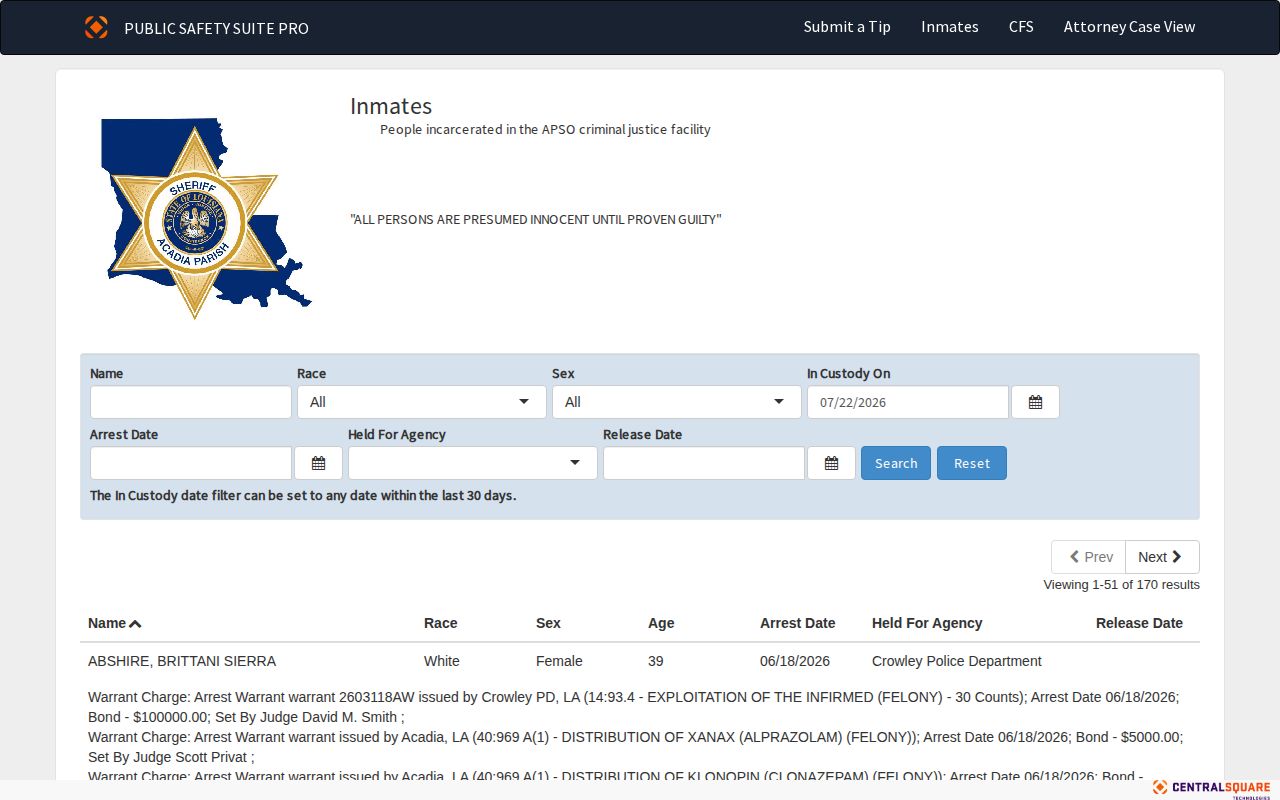
The image documents the calendar filter, not a separate official 72-hour list or a promise that all recent results post at once.
Acadia Weekend Release Review
The wider period can catch release dates missed during a weekend or holiday. However, no official source states that Acadia Parish uses special weekend batches, different processing hours, or a fixed holiday schedule. Do not fill that gap with general jail practice. Use the same four-date method and ask APSO about the precise event when timing matters.
Posting and physical departure may occur at different moments, but APSO has not described the relationship publicly. Repeat a search later if a very recent release is expected. That repeat acknowledges that operational and public systems can differ in timing; it does not prove a set delay. A screenshot should carry the capture time and should never be labeled complete.
The three-day range also raises a counting problem. One person may have several charges under one booking, and a person may have more than one booking. Use a booking number when available. If the portal does not expose one, match the arrest and release dates with identity and agency fields, then describe a result as a booking rather than an unsupported unique-person count.
Acadia Release Calendar Quirks
The exact-date filter is one of Acadia's most useful local features. It makes the work reproducible because another user can run the same dated query. Its design also means the portal cannot be presented as a ready-made 72-hour feed. The date range has to be built outside the portal, one day at a time, and the result must carry its boundaries.
Online lookback and retention are also unknown. A booking that is not visible may be outside portal display, delayed, sealed, expunged, misspelled, or simply unmatched by the selected date. Louisiana retention law relies on approved schedules rather than one universal jail-record period. Ask APSO which schedule applies when an older booking is no longer returned.
A responsible search note can state: reference time, time zone, four dates searched, terms used, number of booking results before and after deduplication, and any direct confirmation. It should say “not publicly located” when nothing appears. That phrasing reports the work without turning a negative portal result into proof.
Verify Acadia Release Destinations
Start with the held-for field. An APSO or municipal agency entry points back to the jail and the Acadia Parish Clerk when a local court action matters. A DPS&C entry points to Louisiana VINE and the state telephone locator. ICE or USICE points to the Online Detainee Locator, while USMS points first to the federal court and then to BOP if the person was committed to a federal sentence.
This source handoff separates three facts that are often blurred. A parish release date proves the end of one booking's APSO custody. A court disposition explains the legal action, such as bond, dismissal, time served, or probation. A receiving-agency record shows whether another custodian took control. One record rarely proves all three.
Release labels need the same separation. A bond figure is not proof that bond was posted. Credit for time served can be part of a longer or suspended sentence. Probation is a community status but does not establish state-prison release. Parole hearing results show a decision, not the moment DPS&C processed a person out. An agency release date paired with the correct court or receiving record gives the sounder conclusion.
For a named-person investigation that must connect those systems, use the Acadia Parish released inmate search. A state P&P result means the person is outside prison under supervision, not fully discharged. An ICE record can mean parish release became immigration detention. A missing result in any one system is not proof of freedom.
Note: A transfer ends APSO custody but must not be counted as a return to the community without destination evidence.
Request Acadia Release Records
When a result is incomplete, call APSO Corrections at 337-788-8737. Ask whether the identified booking ended, the date and time shown, the release type or code, and whether another agency received the person. If staff cannot provide the record by phone, use the APSO contact route for a narrow request. The sheriff publishes no dedicated release-record form, fee schedule, or records hours.
Identify the person, date of birth or booking number if legitimately known, approximate arrest and release dates, and facility. Request the booking/release summary, exact release time, release type, receiving agency, and bond or court reference. Ask for a copy-cost estimate in advance and for the applicable retention schedule if the item is no longer available online. If material is withheld, request the legal basis.
The answer may be not immediately available, not retained, or exempt. Those are not the same. A delay should lead to an availability estimate. A retention answer should identify the schedule and any archived copy. An exemption should identify its statutory basis and allow nonexempt booking information to be separated when possible. This record route closes gaps that a multi-date portal scan cannot resolve.