
Acadia Parish Release Records
A release record marks the end of custody under one booking. It does not always mean the person walked into the community. Acadia Parish Sheriff records can show a dated release from a parish booking, while the held-for agency may point to Louisiana Department of Public Safety & Corrections, another jail, the United States Marshals Service, or ICE. The court file answers a different question: why custody was authorized or ended. Both records may be needed.
A person usually disappears from a current jail roster after that booking closes. The next record depends on the outcome. Bond, recognizance, time served, dismissal, probation, parole, sentence expiration, and transfer have distinct meanings. Transfer, escape, and death are not community releases. A release date should therefore be reported as an agency custody event until the release type or destination is confirmed.
- Release
- The end of custody for a particular booking or agency.
- Discharge
- The end of a custodial or supervision term, as defined by the source record.
- Time served
- Custody credited toward a sentence, which does not by itself mean the case was dismissed.
- Detainer
- A request or authority for another agency to take custody when the current hold ends.
How Acadia Parish Custody Ends
Acadia Parish release records should preserve the agency's exact label. Similar-looking outcomes can lead to very different next steps. A bond order can leave a case pending. A probation sentence puts a person in the community under court-ordered conditions. Parole or diminution release may end confinement while legal supervision continues. A transfer closes the Acadia booking but opens or continues custody elsewhere.
| Release type | What it means | Best next record |
|---|---|---|
| Bond or recognizance | Pretrial custody ends under court terms | Jail release entry and court bond order |
| Time served or sentence end | Custody credited or completed | Release record and signed disposition |
| Probation | Community sentence or split-sentence phase | Judgment and supervising office |
| Parole or diminution | Prison ends before full term, often with supervision | DPS&C record and P&P assignment |
| Transfer | One facility releases custody to another | Releasing and receiving agency records |
The safest statement is that the source agency reports a release from its custody. Add “released to the community” only when a type, destination, or receiving-agency check supports that conclusion.
Acadia Parish Release Record Fields
The public APSO jail portal verifies that Release Date is a searchable field. Its configured results can also show the identifying and booking fields below. A full operational release summary may contain more detail than the portal exposes, so request the narrow record when the exact time, code, or destination matters.
| Field | What it shows |
|---|---|
| Name and identifiers | The person linked to the booking; use more than a name for matching. |
| Arrest or booking date | The start point for that custody event. |
| Release date and time | When the agency recorded the booking as ended; time may require a request. |
| Release type or code | Bond, time served, transfer, court order, or another agency label. |
| Held-for agency | The local, state, federal, or immigration authority connected to the hold. |
| Destination | The community or receiving custodian, when recorded and releasable. |
| Bond, judge, or order | A lead to the legal authority, not proof that processing finished. |
The official portal view below shows the local Release Date control and result structure.
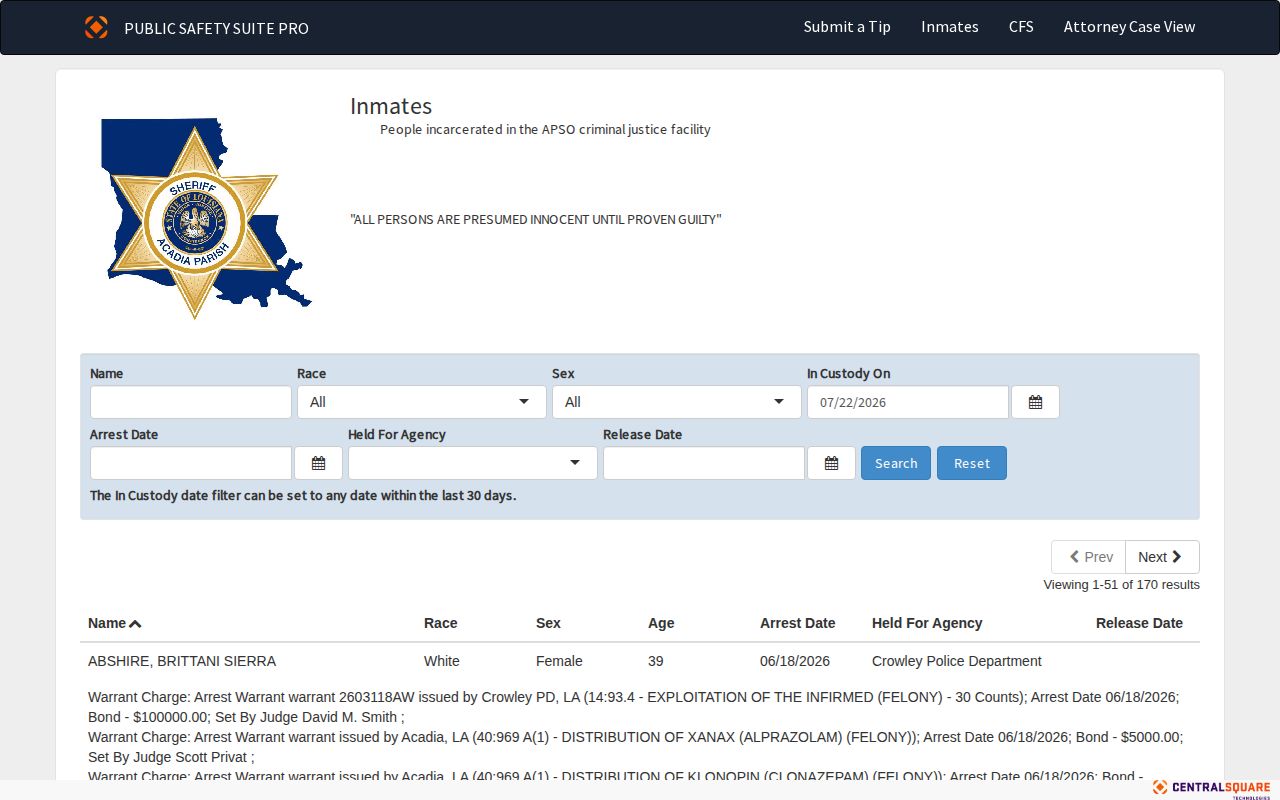
The calendar filter supports a dated booking search, but it does not promise a release type, exact time, or community destination for every result.
Request Acadia Parish Release Records
APSO publishes a main contact channel, but the research found no dedicated release-record form, public jail-copy fee, office hours, or stated portal retention period. Send a precise request to the records custodian through the Sheriff's official contact page, 1037 Capitol Avenue in Crowley, or the main line at 337-788-8700. A narrow request is easier to identify than a demand for every record connected to a person.
- Give the full name, date of birth or booking number if known, approximate arrest and release dates, and facility.
- Ask for booking and release date and time, release type or code, destination or receiving agency, and any bond or court-order reference.
- Request the booking photograph only if legally releasable, and keep that request tied to the identified booking.
- Ask for a cost estimate before copies and for the approved retention schedule if the record is unavailable.
- If material is withheld, ask for the specific legal basis and any segregable public booking information.
Louisiana R.S. 44:32 permits reasonable copy or transmission fees and advance payment. No APSO amount is published, so do not assume the Clerk's fee applies to Sheriff records. If a record is not immediately available, the response should address availability. The five-day enforcement threshold is not a promise of full production within five days.
Does Acadia Parish Bond Mean Release?
No. The portal may display bond and judge details, and the APSO Traffic and Bonds unit processes bonds and court findings. An authorized bond amount does not prove it was posted, that every condition was met, or that processing ended. Another charge or outside hold can keep a person in custody after one bond is satisfied.
Confirm the release date in the APSO portal or through Corrections. Then use the Acadia Parish Clerk file for the bond order and later disposition. This two-record check separates the court's authority from the jail's physical release event. It also prevents a displayed amount from being mistaken for a completed release.
Note: A bond entry is a useful lead, while a dated release record and court order form the stronger proof chain.
Acadia Parish Release Scale
APSO's corrections description reports a 190-bed operation and says more than 2,700 people were processed in 2016. These figures explain why a current roster changes often, but they must remain tied to the source and year. They are not a present annual-release count, and the number processed includes more than community releases.
Turnover makes identifiers and dates vital. Count bookings, not charge lines, and exclude transfers when the question is how many people returned to the community.
Acadia Parish Record Access Laws
R.S. 44:1 broadly defines public records, subject to exceptions. Code of Criminal Procedure article 228 opens the booking book and booking summary, while R.S. 44:3 protects certain investigative material without closing the core article 228 information. Juvenile, sealed, victim-identifying, medical, security, and exempt investigative data can be withheld or redacted.
Online visibility and legal retention are not the same. R.S. 44:36 points to approved retention schedules rather than one universal jail-record period. If an older Acadia Parish release no longer appears online, ask the custodian whether it is retained, archived, sealed, expunged, or exempt. “Not publicly located” is more accurate than “does not exist.”
Acadia Release Court Dispositions
Acadia lies in the Fifteenth Judicial District, yet the Acadia Parish Clerk remains the local custodian for district criminal files. The Clerk's records guidance says criminal files are public unless sealed and offers a public terminal. A disposition costs $10 plain or $15 certified, and a 30-year search costs $20. Those court services are separate from APSO release-record fees.
The official Clerk screenshot illustrates the durable disposition, public-terminal, and expungement route.
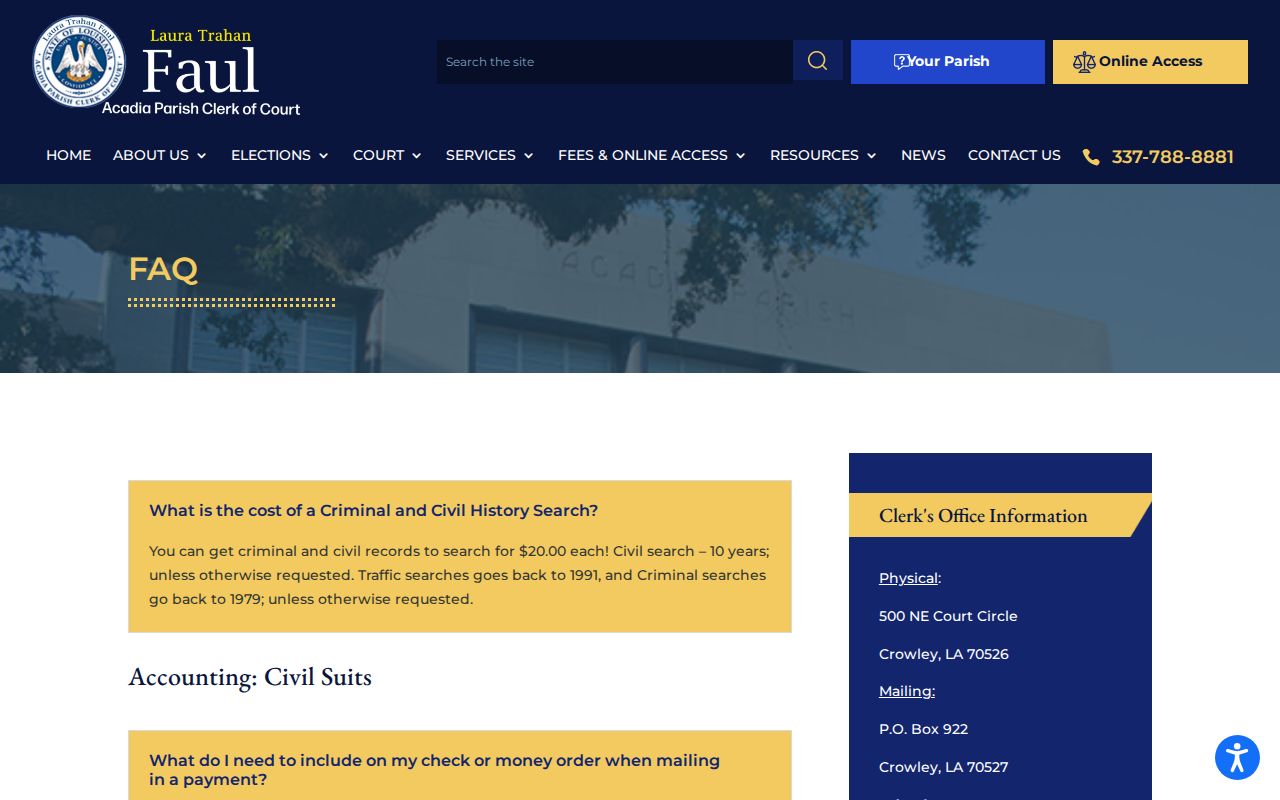
A court disposition explains the case outcome, though APSO remains the better source for the exact physical release time.
Acadia Release Records After Expungement
The ordinary expungement total is itemized at $550, subject to statutory exemptions, and the Clerk says processing can take up to six months after Louisiana receives the order. Under article 972, expungement removes covered records, photographs, fingerprints, and disposition material from public access rather than destroying the underlying records.
A missing portal or court result can therefore reflect restricted access, not a finding that the event never happened. Keep the signed order when available, distinguish public access from agency retention, and do not infer destruction from an empty online search.
Find Acadia Parish Released Inmates
Start with the system that last held the person. A current roster is for people still in that roster's custody. A released Acadia Parish inmate normally needs a dated portal result, a state status or supervision record, a court disposition, or a receiving-agency record. No single search covers every path.
- Search the APSO portal by name, then use Release Date for each plausible calendar day and compare age, arrest date, and held-for agency.
- Call APSO Corrections at 337-788-8737 when the exact time, release type, or destination is missing.
- Check the Acadia Clerk disposition when bond, dismissal, sentence, time served, or probation explains the legal outcome.
- Use Louisiana VINE and the DPS&C telephone locator for a state sentence or active parole and probation.
- Follow ICE, USMS, BOP, another jail, or another parish when the held-for or destination field points there.
- Send a narrow release-record request when no public result answers the question.
A roster disappearance is ambiguous. It can mean community release, transfer, a feed change, or another custody event.
For a rolling same-day method, use the Acadia Parish 24-Hour Releases date-boundary process. That page addresses a feed window, while the steps above verify one named person across systems.
Acadia Parish Release Date Search
The APSO portal is distinctive because it includes an exact calendar Release Date filter. It does not publish a separate rolling 24-hour or 72-hour feed. Search today and yesterday for an exact 24-hour interval, or every date intersecting a 72-hour interval. State which dates were checked. If a result lacks time, it proves a calendar-date release but not that the event falls inside an exact clock window.
Configured fields include mugshot, name, race, sex, age, arrest date, held-for agency, and release date. Details may add charge or hold reason, bond, and judge. A photograph may be null. APSO has not published cadence or lookback limits, so do not describe the portal as real-time or promise how long a released booking stays visible.
Louisiana Search for Acadia Releases
DPS&C directs the public to Louisiana VINE/LAVNS, which covers incarceration and active parole or probation and is described as updating every 24 hours. Search by location, name, or ID/case number, then compare the custody status, location, offender number, and any release, sentence, or court fields supplied. A P&P result means the person is in the community under supervision, not fully discharged.
| Search field | Use | Limit |
|---|---|---|
| Name | Start a person search | Same-name matches require more identifiers |
| ID or case number | Narrow to the agency record | Must be entered accurately |
| Location | Review custody or supervision source | A parish facility can house a state prisoner |
| Status and release fields | Read the reported custody change | Field population varies by agency |
The DPS&C inmate-information page documents the state locator and its exact projected-date wording.
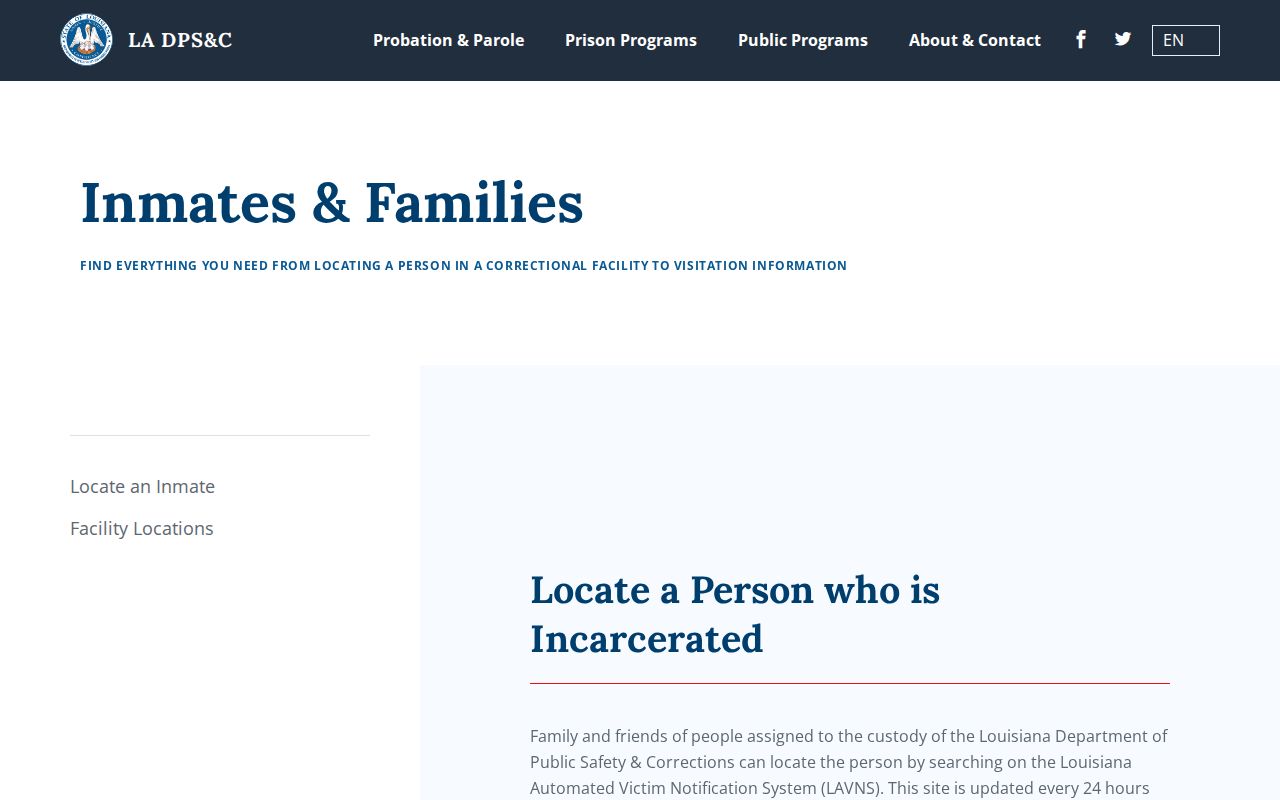
The telephone locator at 225-383-4580 can provide housing, facility contact, and “projected release date (if applicable),” while time computation uses 225-342-0799.
Acadia Release Supervision and Reentry
Louisiana probation and parole are different community statuses. Parole follows incarceration, while probation can follow a suspended or local sentence without state-prison service. Acadia is served by Lafayette District P&P. Active supervision may appear in LAVNS, and the telephone locator may identify the assigned district. Final discharge can remove an active entry, so a missing result is not proof that every term ended.
DPS&C's Return for Good transition framework describes a standardized prerelease curriculum for eligible participants, with a community phase that continues from release through supervision discharge. Lafayette also has a Day Reporting Center. These are support and routing facts, not promises that a particular released person qualifies for a service.
More verification detail appears on the Acadia Parish Post-Release Supervision page.
Identity Documents After Acadia Release
DPS&C transition staff work to assemble at least two identity documents during the agency's prerelease process. The published framework includes requests for replacement birth or Social Security records when needed and creation of an Office of Motor Vehicles state ID. This document work applies to the DPS&C process described by the agency, not automatically to every person leaving a parish or city jail.
Keep release paperwork, the release certificate, supervision instructions, and any court order together. They answer different questions. The custody record confirms the physical event, the court order explains legal authority, and P&P instructions identify current duties. APSO has not published local property-return or release-exit procedures, so those details must be confirmed directly rather than inferred from state practice.
Acadia Projected Release Law Split
Louisiana's offense-date split makes a general “85 percent” claim unsafe. For eligible offenses committed on or after August 1, 2024, R.S. 15:571.3.1 permits diminution up to 15 percent of the imposed sentence, with exclusions and conditions. Earlier offenses remain under the varied cohorts in R.S. 15:571.3. Sex-offense, habitual-offender, offense-date, sentence, forfeiture, and other rules can change eligibility.
A projected date is an administrative estimate, not proof of release. Sentencing paperwork, credit, sentence structure, earned credit, discipline, and amended orders can change it. Never calculate an individual's date from a percentage alone. Use DPS&C's Master Prison Record and correction channels for a disputed state computation.
Federal and ICE Acadia Releases
A held-for entry for ICE/USICE is locally important because the South Louisiana ICE Processing Center operates in Basile. Leaving APSO for ICE is a transfer, not community release. ICE ODLS searches by A-number and country of birth or exact biographical information and can include many people released from ICE custody within the prior 60 days. Coverage can lag, minors are excluded, and release paperwork governs later check-ins.
For a federal sentence, the BOP locator covers federal inmates from 1982 onward. A past release date with no facility indicates departure from BOP custody, but it does not rule out state or local custody or federal supervised release. Federal pretrial events belong in the court docket and, where appropriate, a narrow USMS inquiry. USMS has no comparable public prisoner locator.
An ICE detainer does not prove pickup. Connect the APSO release or destination record to the receiving system.
Where Acadia Release Status Appears
Each system answers a bounded question. Use the row that matches the last known legal and physical custody, then follow any destination to the next custodian.
| Status sought | Best source | What it establishes |
|---|---|---|
| Still in parish custody | Current APSO roster or Corrections | Present parish booking status |
| Released from an APSO booking | Portal Release Date and release summary | End of that parish booking |
| Case outcome | Acadia Clerk disposition | Legal result, not necessarily exit time |
| State custody or active supervision | LAVNS and DPS&C locator | Reported state location or P&P status |
| Federal or immigration event | BOP, ICE, court, or USMS record | That federal system's custody change |
Acadia Parish Release Facilities
Official directories use several local labels, while APSO describes one 190-bed corrections operation. Retain the names and contacts without inventing separate populations. The Criminal Justice Center is listed as an office, not a verified independent jail roster. Rayne City Jail is a municipal channel. South Louisiana ICE is a separate federal immigration facility.
- Acadia Parish Detention Center: verify community release or transfer through the APSO record and destination.
- Acadia Parish Jail: use the same Release Date portal and jail line, then follow outside holds.
- Acadia Parish Criminal Justice Center: route custody questions to APSO Corrections because no distinct population is verified.
- Rayne City Jail: confirm a municipal release or parish transfer with Rayne and APSO.
- South Louisiana ICE Processing Center: use ODLS, the facility, and immigration release paperwork.
Louisiana state custody may be housed inside or outside Acadia Parish. Geography alone does not reveal whether the sentence is local, state, federal, or immigration custody.